written for the November 2025 Brown County, Indiana Historical Society newsletter
September’s pitch-in featured State Park Naturalist Eli Major, and he presented on the topic of Hoosier authors inspired by nature. This was Eli’s second program with us. Both times members had MANY questions, e.g.: ‘Are there plans to reintroduce elk to The Park?’ and ‘Is work being done to reintroduce the American Chestnut tree?’ This newsletter is an opportunity to explore such good questions.
Nut Trees in Brown County
Brown County historian Sam Johnson (1924-2000) dedicates an entire Brown County Yesteryears episode to nut trees, and from Johnson we learn the following: Nut trees native to the county include Hickory, Chestnut, Hazelnut, Walnut and Butternut. Prehistoric and historic peoples and animals were sustained by this highly nutritious and easily storable food. Artifacts found locally include nutting stones and evidence of nutting pits. Nutting stones with nut-sized grooves are presumed to have been used to easily crack nuts. Pits dug in the earth are surmised to have been lined with animal skin, filled with water, and lastly with hot rocks, heated in a fire. Boiling crushed nuts would have been an efficient means to separate the oils and meats from the shells. The use of these tools (which date to ~2500 B.C.) would have greatly increased calorie intake.
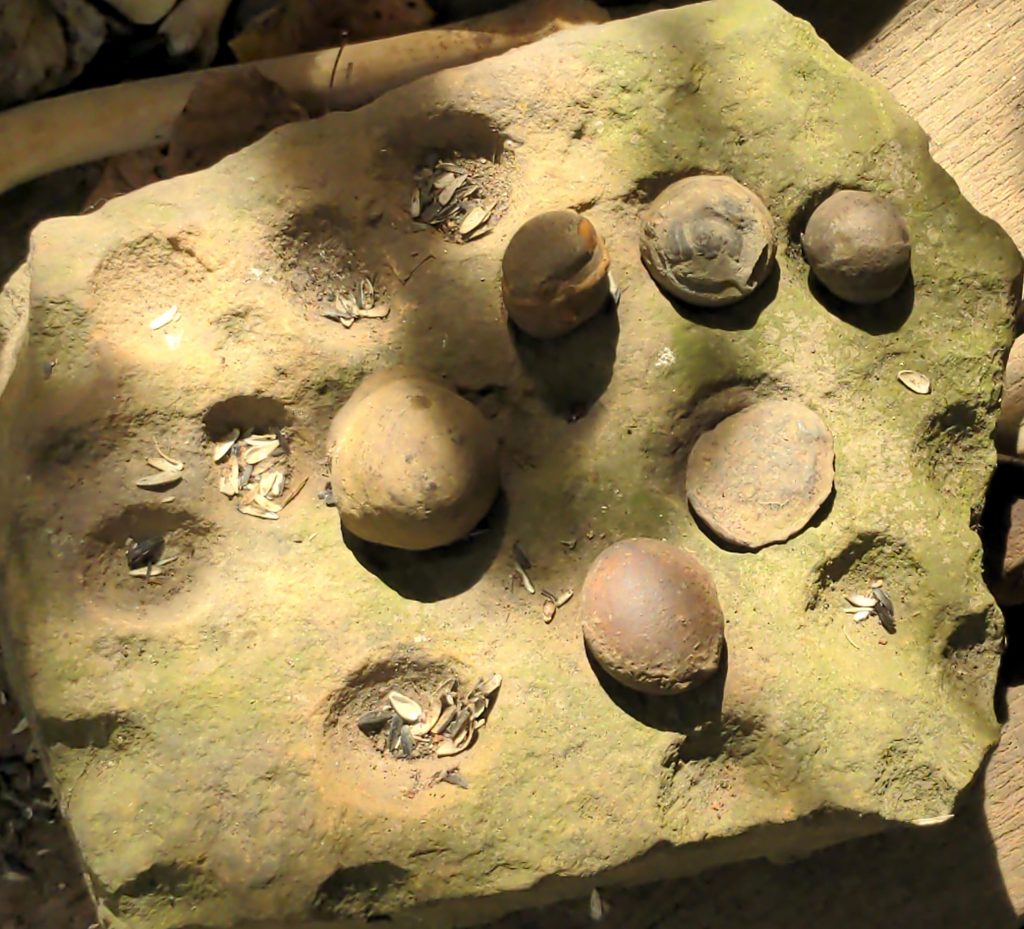
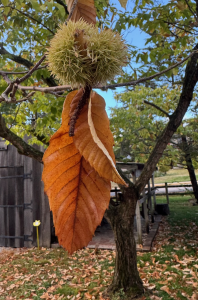
The Historical Society’s grounds have been thoughtfully landscaped to support the appreciation of local history. A Hazelnut, two Black Walnuts, and a Chinese Chestnut can all be found on museum property.
The American Chestnut
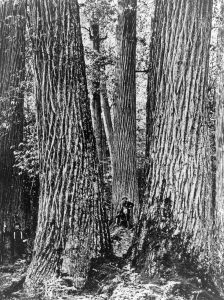
The Chinese Chestnut, however, is not native. Asian varieties first arrived in this country in the 19th century to serve a more decorative purpose because our American Chestnut was a behemoth. It was revered as The Sequoia of the East, also King or Queen of the Forest. Under the best conditions, it could reach 120 feet in height and 8 feet (or more) in diameter!
Brown County lies on the edge of the American Chestnut’s one-time dominion. In the heart of its range, it once accounted for 25 percent of the forest — until the Chestnut blight arrived and decimated its rule. The blight, which is a fungus, arrived from Asia and left the American Chestnut functionally extinct.
First reported in 1904 at New York’s Bronx Zoo, the blight spread rapidly. Southern Indiana was affected by 1940. Four billion trees were lost over the Appalachian range. Eli Major reminds us that most of Southern Indiana was deforested between 1850 and 1900, so the tragedy was not experienced to the same degree here as in places such as Pennsylvania.
The Future of the American Chestnut
Since the 1980s, The American Chestnut Foundation has been working to create a blight resistant tree through cross pollination with the Chinese Chestnut. This new variety is named the Resurrection Chestnut and is 96% American Chestnut.
Steve Grubbs, brother of our curator, Barbara Livesey, has been active in this effort for 25 years. He has planted and distributed 100s of Chestnut hybrids in Brown and Morgan counties. About 50 hybrids are thriving on his southern Brown County property, while 30 to 40 area residents are enjoying similar success because of his work. Somewhat recently, Steve planted two Chestnut hybrids on Historical Society property, but they did not take. Steve believes the soil, largely disturbed by construction, played a role in their demise.
The history of the American Chestnut is still being written. To join the story, visit The American Chestnut Foundation at www.TACF.org. Chestnut enthusiasts may also acquire pure and hybrid starters thanks to Purdue’s Department of Forestry and Natural Resources, in partnership with Tree Pro West Lafayette.
Sources: Johnson, S., “BC Yesteryears: Nuts of BC”; Steve Grubbs, local naturalist; The American Chestnut Foundation; & James McKenna, who works with both TACF Indiana and Purdue FNR.